

 English
Which Preform Weight Matches Your Bottle Volume? A Practical Guide
Content
- 1 Why Preform Weight Matters More Than Most Buyers Expect
- 2 30mm Preforms: The Standard for Still Water and Everyday Beverages
- 3 28mm PCO Preforms: Built for Carbonation Pressure
- 4 38mm Preforms: Wide-Neck Formats for Juice, Tea, and Sports Drinks
- 5 Four Factors That Shift the Optimal Weight Within a Range
- 6 How to Approach a Weight Selection Conversation with Your Supplier
Choosing the wrong preform weight is one of the most common—and costly—mistakes in beverage packaging procurement. Too light, and your bottles will deform under filling pressure or collapse during transport. Too heavy, and you are paying for excess material on every single unit, across millions of bottles. The relationship between preform weight and bottle volume is not a fixed formula; it depends on neck size, wall thickness, bottle shape, and the type of liquid being filled. This guide walks you through the practical ranges used across the industry, so you can enter a supplier conversation—or place an order—with confidence.
Why Preform Weight Matters More Than Most Buyers Expect
Preform weight directly determines how much PET material is stretched across the final bottle wall. During the blow molding process, the preform is reheated and inflated inside a mold. The amount of material available—the preform's gram weight—sets the physical limits of the bottle's wall thickness distribution. An under-weighted preform cannot stretch uniformly into a larger bottle without creating thin spots, particularly at stress points like the base corners and shoulder curve.
On the other hand, over-specifying weight adds raw material cost per unit and may result in bottles that are stiffer than needed, affecting consumer experience and label adhesion. For high-volume beverage producers filling tens of millions of bottles per year, even a 1g difference in preform weight has a significant cumulative impact on material spend.
The correct weight is not simply about hitting the target volume—it is about ensuring structural integrity, consistent blow molding results, and cost efficiency across your entire production run.
30mm Preforms: The Standard for Still Water and Everyday Beverages
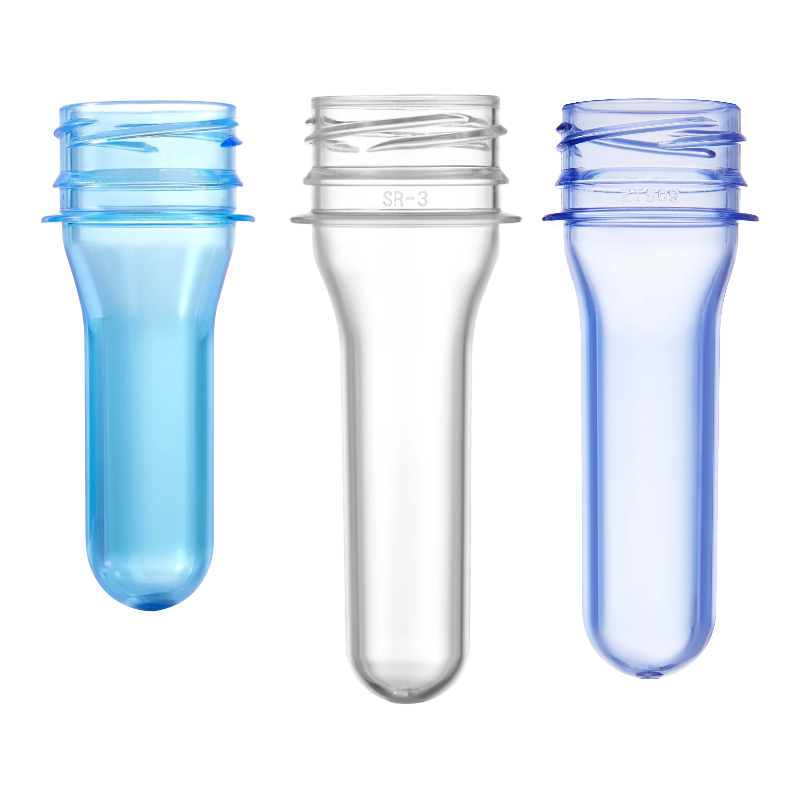
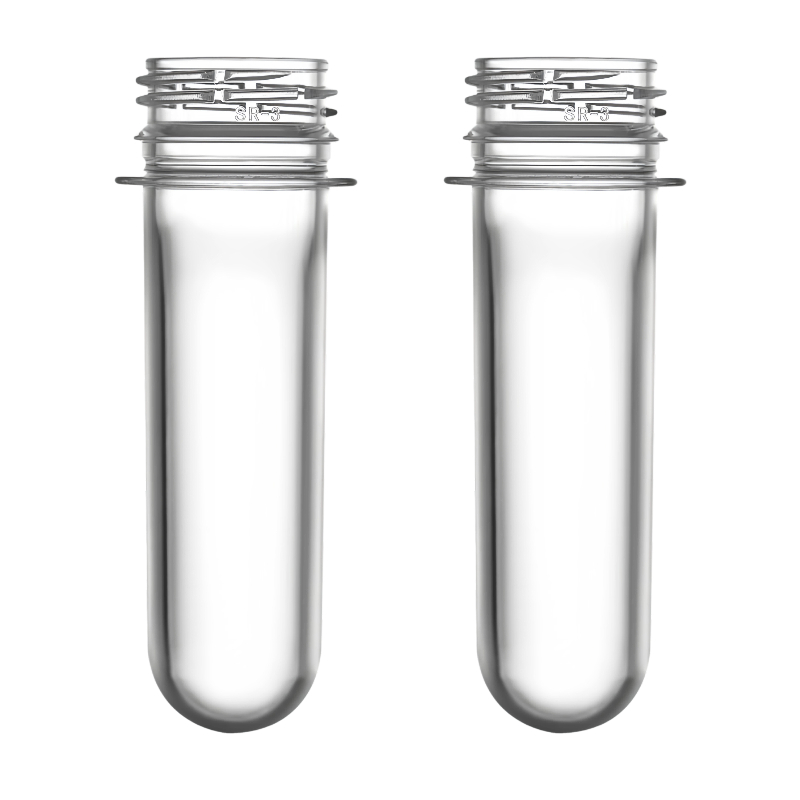
The 30/25 neck finish is the most widely used specification for still mineral water and everyday non-carbonated beverages. It covers a broad volume range—from compact 250ml single-serve bottles to 2.5L family-size containers—making it the default choice for most bottled water producers.
The weight-to-volume relationship for 30mm PET preforms follows a clear progression. Lighter preforms in the 13g–15g range are appropriate for small-format bottles between 250ml and 400ml. As volume increases, wall demands increase proportionally, requiring heavier preforms in the 17g–22g band for 500ml to 650ml bottles. For large-format containers at 1L and above, weights from 30g to 38g are standard.
| Preform Weight | Suitable Bottle Volume | Typical Application |
|---|---|---|
| 13g | 250 – 330 ml | Small single-serve water |
| 14g – 15g | 300 – 400 ml | Compact water / light beverage |
| 17g – 20g | 500 – 650 ml | Standard 500ml water bottle |
| 22g – 27g | 550 – 800 ml | Mid-size water / table water |
| 30g – 32g | 1,000 – 1,500 ml | 1L / 1.5L water bottle |
| 35g – 38g | 1,500 – 2,500 ml | Large family-size water |
Note that within each weight band, there can be overlap between adjacent volume ranges. This is intentional: the ideal weight within a range depends on your specific bottle shape, particularly how slender or barrel-shaped the body is. A tall, narrow 500ml bottle may need a slightly heavier preform than a short, wide bottle of the same volume, because the material must stretch further along the body length.
28mm PCO Preforms: Built for Carbonation Pressure
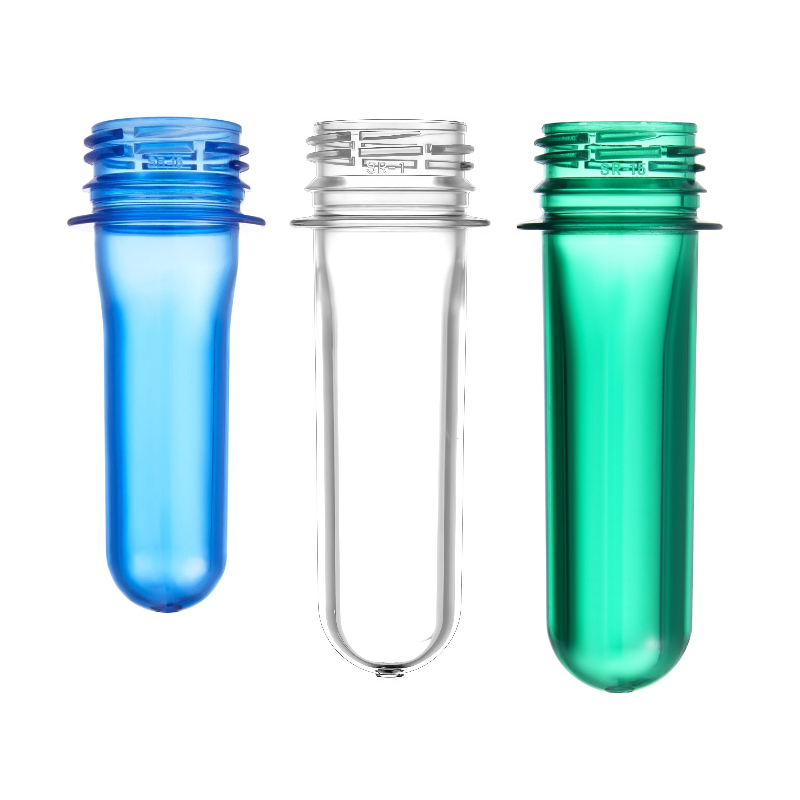
The 28mm PCO neck finish—available in both PCO 1881 and PCO 1810 variants—is the global standard for carbonated soft drinks, sparkling water, beer, and similar pressure-bearing beverages. The key engineering difference is the discontinuous thread design, which allows carbonation pressure to vent safely rather than build up in the neck area.
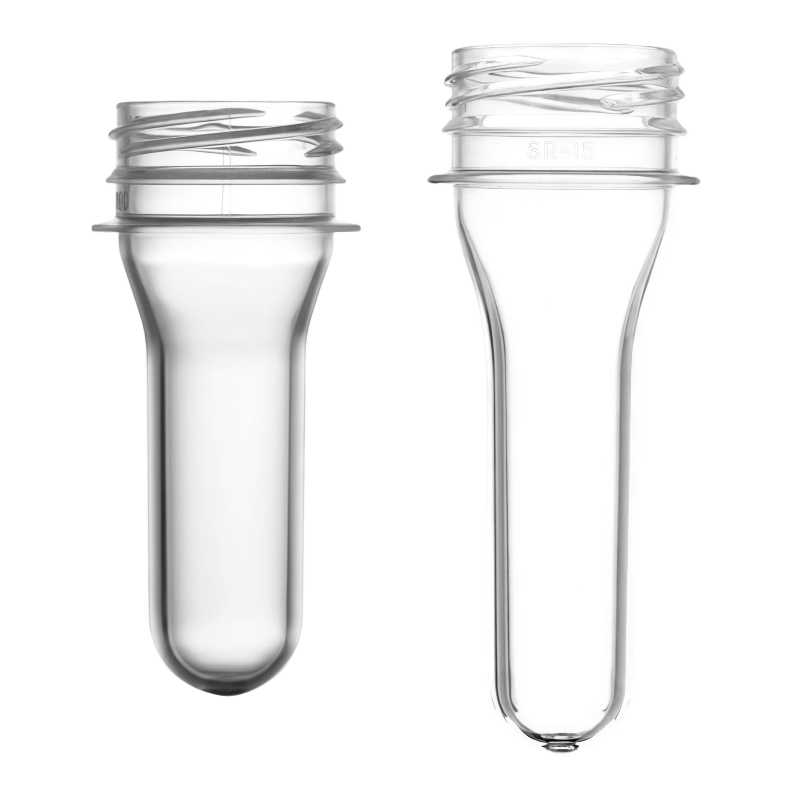
Because carbonated bottles must withstand internal pressure during filling, transport, and storage, 28mm PCO preforms are typically heavier than their 30mm still-water counterparts at equivalent volumes. A 500ml carbonated beverage bottle commonly requires a 22g to 27.5g preform—noticeably heavier than the 17g–20g range used for still water of the same volume.
| Preform Weight | Suitable Bottle Volume | Typical Application |
|---|---|---|
| 13.3g – 13.5g | 250 – 300 ml | Small carbonated / sparkling water |
| 15g | 300 – 400 ml | Small CSD / sparkling drink |
| 22g – 27.5g | 500 – 600 ml | Standard 500ml CSD / cola / beer |
| 37g | 650 – 750 ml | Large carbonated bottle |
| 46g | 750 – 1,000 ml | 750ml – 1L carbonated party bottle |
| 51g | 1,000 – 1,500 ml | 1L – 1.5L large carbonated bottle |
The extra weight in carbonated preforms is not over-engineering—it is a necessary design margin. Under repeated thermal cycling and pressure loading during hot-fill or cold-fill production, thinner walls are more vulnerable to stress cracking. Selecting the correct preform weight at the outset prevents yield loss and returns downstream.
38mm Preforms: Wide-Neck Formats for Juice, Tea, and Sports Drinks
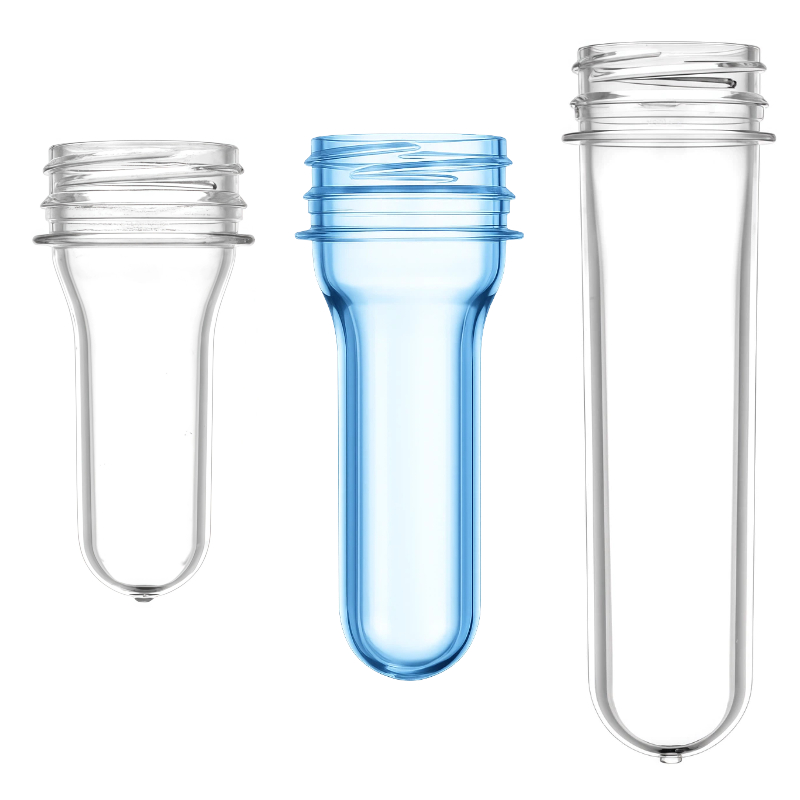
The 38mm neck finish serves a distinct market segment: juice, iced tea, sports drinks, and functional beverages where a wider opening improves consumer drinking experience and simplifies filling line operations. The larger neck diameter means more PET material is concentrated at the top of the preform, which shifts the weight distribution compared to narrower neck types.
As a result, 38mm preforms of equivalent volume tend to be heavier than 30mm versions. A 250ml–300ml juice bottle typically requires a 23g–26g preform—significantly more than the 13g–15g range used for 30mm still water of the same volume. This premium reflects the wider neck material requirement and the generally thicker walls needed for juice and tea applications, which are often hot-filled.
| Preform Weight | Suitable Bottle Volume | Typical Application |
|---|---|---|
| 23g – 26g | 250 – 300 ml | Small juice / sports drink |
| 30g – 36g | 300 – 550 ml | Standard juice / iced tea |
| 45g | 500 – 650 ml | 500ml sports / functional drink |
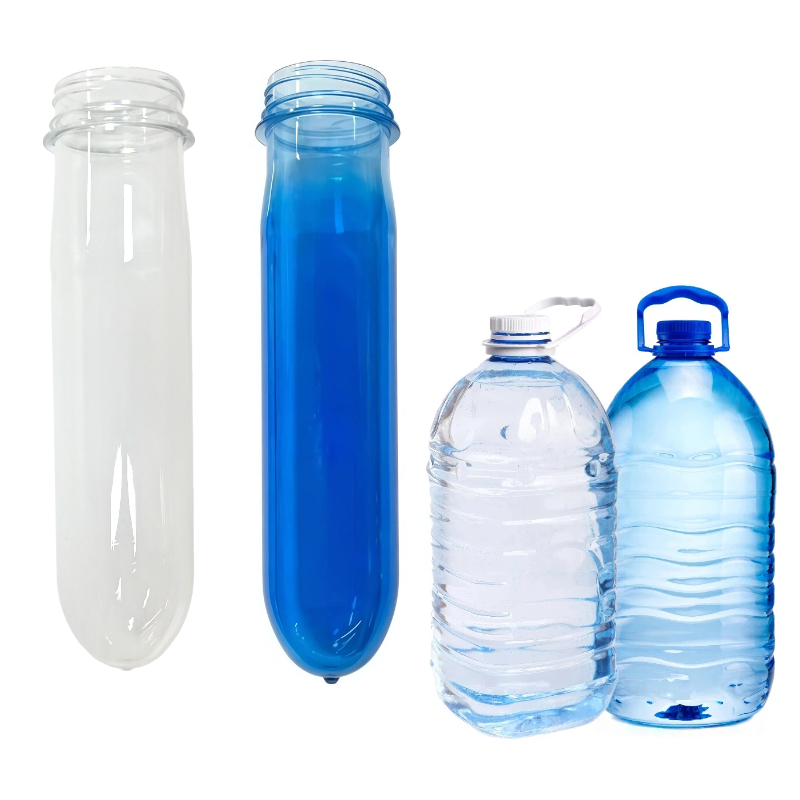
| 54g – 58g | 750 – 1,500 ml | Large juice / multi-serve beverage |
Four Factors That Shift the Optimal Weight Within a Range
The tables above represent industry reference ranges, not absolute rules. Several practical variables will move the optimal preform weight within—or occasionally outside—these bands:
- Bottle geometry: Tall and narrow bottles require the material to stretch further axially, typically pushing weight toward the upper end of the range. Short and wide bottles distribute stretch more evenly, often allowing the lower weight to work.
- Fill temperature: Hot-fill applications (common for juice and tea) cause the bottle to experience a vacuum as the liquid cools and contracts. Preforms for hot-fill applications must produce thicker walls to resist panel deformation, requiring heavier specifications than cold-fill equivalents of the same volume.
- Carbonation level: Higher CO₂ volumes exert greater internal pressure, demanding heavier-walled bottles and correspondingly heavier preforms. Beer and high-carbonation soft drinks sit at the upper end of weight ranges.
- Distribution and handling conditions: Products shipped long distances, stacked under heavy pallets, or exposed to temperature extremes during storage may require a heavier preform to maintain structural performance throughout the supply chain.
When any of these factors applies to your product, it is advisable to consult your preform supplier directly rather than relying solely on standard weight tables. A supplier with experience across beverage categories can quickly narrow down the most cost-effective specification for your exact use case.
How to Approach a Weight Selection Conversation with Your Supplier
When reaching out to confirm or finalize a preform weight, prepare the following information in advance. This will allow your supplier to provide an accurate recommendation without unnecessary back-and-forth:
- Target bottle volume (in ml)
- Neck finish required (28mm PCO / 30mm / 38mm)
- Beverage type (still water, carbonated, juice, hot-fill, etc.)
- Bottle shape description or existing bottle sample / drawing
- Fill process (cold fill, hot fill, aseptic)
- Any existing preform weight or mold reference you are working from
We supply a full range of PET preforms across 28mm, 30mm, and 38mm neck types, with weight options spanning from 13g to 58g to cover virtually every standard beverage format. Our team regularly assists procurement managers and packaging engineers in matching preform weight to bottle design—feel free to contact us with your specifications for a direct recommendation.